
Emoluments
An emolument is a payment or benefit tied to office. The Constitution has two clauses about them, and together they are the country’s oldest anti-corruption rules. They are also among the least developed.
Almost nothing has been written about these clauses by the courts. For most of American history nobody litigated them, so there is very little case law, a handful of executive-branch opinions, and a short founding-era record to work from.
That thin record matters, because the clauses are widely assumed to do more than they say. The common belief is that they bar the President from any personal profit. They do not. Both clauses are limited by their source: they reach money and benefits that come from a government, foreign or domestic, not private income in general. And the one question that actually divides people, whether an ordinary commercial transaction with a government counts as an "emolument," has never been settled by a binding court.
In plain terms, an emolument is a profit, gain, or advantage. In founding-era usage the word covered both the pay that came with holding an office and, more broadly, profit from private dealings. The Framers used it both ways.
In the litigation over these clauses, that breadth became the whole fight. Two readings were argued:
- Narrow: an emolument is a benefit received in return for official services, or through an office, employment, or agency relationship with a government. On this reading, a foreign diplomat paying the going rate for a hotel room is a market transaction, not an emolument.
- Broad: an emolument is any profit, gain, or advantage from a government source, including ordinary commercial patronage.
Only one court has ever squarely chosen between them, adopting the broad reading in 2018. No appeals court reached the question, and in 2021 the Supreme Court wiped the lower-court rulings off the books as moot. So there is still no authoritative definition of the word.
Foreign Emoluments (applies to everyone)
"No Title of Nobility shall be granted by the United States: And no Person holding any Office of Profit or Trust under them, shall, without the Consent of the Congress, accept of any present, Emolument, Office, or Title, of any kind whatever, from any King, Prince, or foreign State."
- Applies to every federal officeholder, not just the President. Anyone holding an office of profit or trust is covered.
- The source must be a foreign government (a king, prince, or foreign state), not a private party.
- Congress can consent. With congressional approval, the gift or benefit is allowed. This is a safety valve the other clause does not have.
The clearest guidance on record is an 1871 Attorney General opinion: a U.S. minister abroad may do a foreign power a friendly service, even help negotiate a treaty, but may not accept a formal commission as that power’s own minister, because that makes him its officer. Read it: 13 Op. Att’y Gen. 538 (1871) →
Open question: some scholars argue this clause does not reach the President at all, on the theory that the Presidency may not be an "Office of Profit or Trust under the United States." A court rejected that argument in 2018, but the ruling was later vacated, so it remains unsettled.
Domestic Emoluments (applies to the President)
"The President shall, at stated Times, receive for his Services, a Compensation, which shall neither be encreased nor diminished during the Period for which he shall have been elected, and he shall not receive within that Period any other Emolument from the United States, or any of them."
- Applies only to the President.
- The source must be the federal government or a State. It does not touch private income.
- There is no congressional consent option. The President gets a fixed salary and nothing else from any government in the Union.
The purpose is the same anti-corruption idea, pointed inward: neither Congress nor a state legislature should be able to reward or pressure a President by adjusting his pay or handing him extra benefits.
The Foreign Gifts and Decorations Act (5 U.S.C. § 7342) is how Congress has exercised the consent the Foreign clause contemplates. It lets federal employees keep gifts of minimal value from foreign governments, sends larger gifts to the United States, and requires annual public reporting. Read the statute: 5 U.S.C. § 7342 →
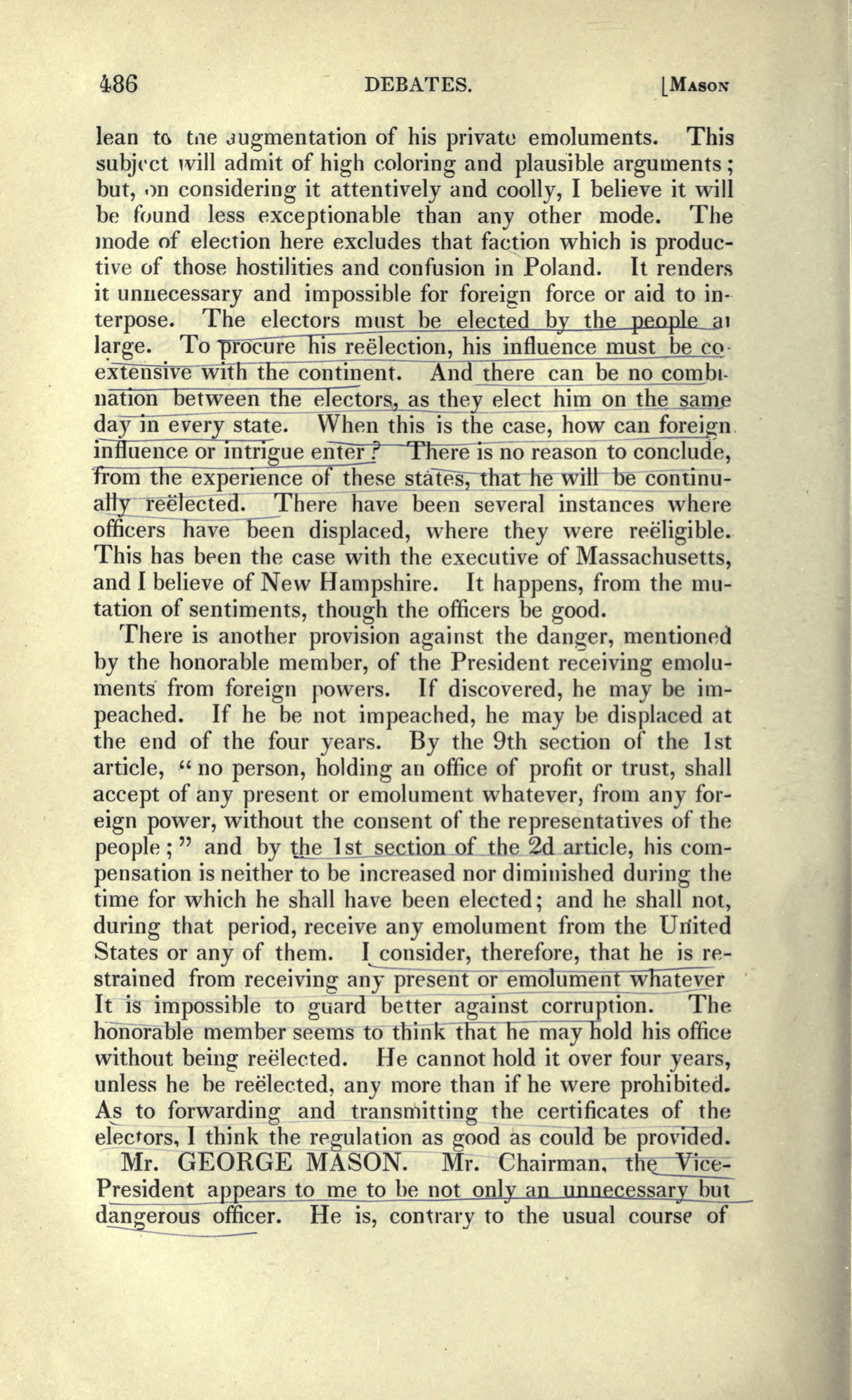
With almost no case law, the founding-era debates carry unusual weight. The Framers and the ratifying conventions described these provisions plainly as anti-corruption rules aimed at foreign influence over public officials, the President most of all.
The modern emoluments question reached the courts for the first time during Donald Trump’s first term, over foreign and government patronage of his hotels. None of the cases produced a lasting ruling on what the clauses mean.
More than 200 members of Congress sued over foreign business payments. Dismissed because the lawmakers lacked standing to sue.
A watchdog group sued over the President’s New York and D.C. properties. The appeals court found standing and sent the case back, but it never reached a ruling on what the clauses mean.
The only case where a court read the clauses on the merits. A district judge adopted the broad definition, calling them "broad anti-corruption provisions." The appeals fights were about procedure, not meaning.
After the President left office, the Supreme Court declared the cases moot and vacated the lower-court judgments. The broad reading no longer stands as law.